China’s orthopedic implant sector is often discussed through price and production scale. Quality requires a closer look. What are the key indicators for high-quality orthopedic implants? The answer begins with material traceability, precise manufacturing, validated testing, and evidence that supports safe clinical use. A polished titanium surface or a clean package is not enough.
Former FDA CDRH director Dr. Jeffrey Shuren has emphasized a core device principle: medical devices should be safe and effective. This is a paraphrase of the FDA’s stated mission, not a verbatim quotation. For implant buyers, that principle points toward practical checks: documented material specifications, consistent dimensions, sterile packaging, and clear quality-control records. Ask how each production batch is inspected. Ask whether test results and technical documents can be reviewed. Details matter.
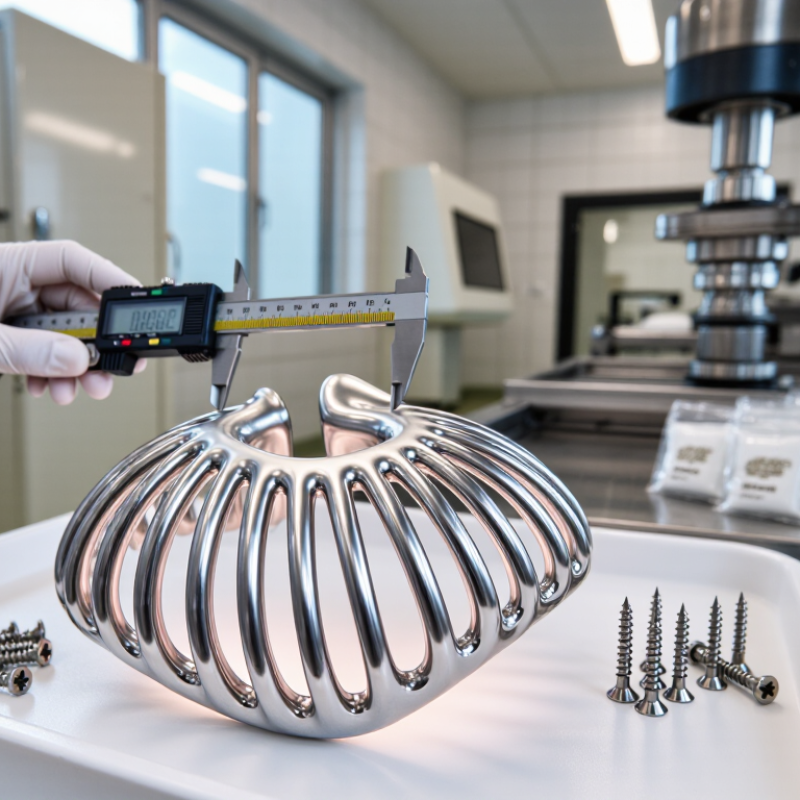
Clinical performance matters too. Implant design should suit its intended use, and claims should be supported by appropriate testing and follow-up evidence. A factory visit can reveal useful details: calibrated measuring tools, controlled storage, and staff who can explain inspection steps. But one visit cannot prove long-term outcomes. That distinction is easy to miss.
A reliable supplier should communicate limitations, not only strengths. Compare evidence, manufacturing controls, and after-sales support rather than relying on a single certificate or attractive brochure. No checklist removes all uncertainty. That is worth remembering. For readers assessing Chinese manufacturers, careful verification offers a more grounded starting point than country labels or marketing promises.
Materials Used in High-Quality Orthopedic Implants
Material choice affects an implant’s strength, weight, corrosion resistance, and interaction with surrounding tissue. Titanium alloys are widely used for joint components, screws, and plates. They are relatively lightweight and can support bone integration when their surfaces are appropriately designed. That matters. Cobalt-chromium alloys offer strong wear resistance, making them useful in some bearing surfaces. Stainless steel remains common in certain fixation devices, though its use depends on the intended application and patient factors.
The material is only part of the story. High-quality implants also require controlled manufacturing, careful surface finishing, and testing for fatigue and corrosion. Polymers such as ultra-high-molecular-weight polyethylene may serve as bearing components, where repeated movement can gradually produce wear. Ceramic materials can provide hard, smooth bearing surfaces, but their performance depends on design and handling. Details count. Material specifications and batch traceability help clinicians and manufacturers assess whether components meet defined quality requirements.
No material is perfect. A metal’s strength does not guarantee the best choice for every patient, and laboratory results cannot fully predict years of movement inside the body. Selection should consider the implant’s purpose, the patient’s anatomy, and clinical evidence. Even expert material comparisons have limits; that is worth acknowledging. A reliable implant is built from suitable materials and consistent processes, then evaluated for its specific use.
| Material | Common Orthopedic Applications | Relevant Material Characteristics | Quality and Selection Considerations |
|---|---|---|---|
| 316L stainless steel | Bone plates, screws, wires, and other fixation devices | Offers good corrosion resistance, strength, and formability. Medical implant grades are produced and controlled for consistent composition and cleanliness. | Appropriate performance depends on the device design, manufacturing quality, surface condition, and the intended duration and environment of implantation. |
| Titanium and titanium alloys | Bone screws, plates, intramedullary nails, spinal devices, and joint components | Titanium is relatively lightweight and forms a stable oxide layer that supports corrosion resistance. Ti-6Al-4V ELI is a widely used implant alloy with a high strength-to-weight ratio. | Surface finish and design affect fixation and bone response. Titanium alloys can be susceptible to wear in articulating contact, so they are not suitable for every bearing surface. |
| Cobalt-chromium-molybdenum alloy | Selected hip and knee joint components, including some femoral components | Known for high strength, hardness, and wear resistance, making it useful for components exposed to repeated loading and contact. | Its stiffness and wear behavior must be considered alongside component geometry and the opposing bearing material. Performance depends on manufacturing and surface finishing. |
| Ultra-high-molecular-weight polyethylene (UHMWPE) | Acetabular liners in hip replacements and tibial inserts in knee replacements | A low-friction polymer used as a bearing surface. Modern formulations may include cross-linking to improve wear resistance. | Wear particles and long-term bearing performance are important considerations. Material processing, sterilization, component design, and compatibility with the opposing surface all matter. |
| Alumina and zirconia-toughened alumina ceramics | Selected hip replacement heads and bearing components | Hard, smooth, and wear-resistant materials with high compressive strength. Zirconia-toughened alumina combines ceramic constituents to improve toughness compared with monolithic alumina. | Ceramics are brittle compared with metals and require careful design, manufacturing, inspection, and handling. Their suitability depends on the complete implant system. |
| Porous tantalum | Selected acetabular components, revision implants, and other devices where bone ingrowth is desired | Its porous structure can provide space for bone ingrowth and biological fixation. The material is also corrosion resistant. | Porosity, structural integrity, and surface architecture need careful control. Its use is application-specific and does not replace appropriate surgical technique or patient assessment. |
Note: No single material is best for every orthopedic implant. High quality also depends on validated manufacturing, material traceability, device design, surface treatment, testing, and compliance with applicable regulatory requirements. Material choice should match the implant’s function and clinical application.
Titanium alloys are lightweight and may support bone integration. Cobalt-chromium resists wear, while stainless steel is used in some fixation devices.
A hip bearing surface faces repeated movement and wear. A fixation plate has different demands. No material suits every patient.
Ultra-high-molecular-weight polyethylene can serve as a bearing component. Ceramic surfaces can be hard and smooth, but design and handling matter.
Controlled machining, surface finishing, cleaning, and calibrated equipment help maintain consistency. Tiny differences in a screw thread can matter.
Ask how critical dimensions are measured and how often tools are calibrated. Check batch-linked material and inspection records.
It should cover relevant material, dimensional, mechanical, and fatigue tests. Repeated-load testing can reveal deformation or failure in a component.
No. A certificate supports controlled production, but it does not prove every device fits every use. Read the actual records.
Verify that authorization applies to the specific device and destination. Review sterilization evidence and whether packaging maintains sterility through its stated shelf life.
Not completely. Patient anatomy and movement vary. That limitation is easy to overlook, even in a careful report.
High-quality orthopedic implants are defined by more than the materials they use. Biocompatible metals and polymers must offer appropriate strength, durability, and resistance to wear, while implant shapes and dimensions should support anatomical fit, secure fixation, and natural function. Careful design also considers how components interact with bone and surrounding tissue, helping clinicians select options suited to different patient needs.
What are the key indicators for high-quality orthopedic implants? Consistent manufacturing precision, documented quality controls, and relevant testing provide important evidence of reliability. Certification and regulatory compliance should be assessed alongside the methods used to verify material properties, dimensions, and performance. When comparing Chinese manufacturers, buyers and healthcare professionals can also review clinical evidence, production consistency, traceability, and transparent technical documentation. Considering these factors together offers a balanced way to evaluate implant quality rather than relying on a single specification.

 HBM Medical